Home
Home
Why OpenClaw AI Agent Security Issues Are a Critical Risk for Your Data
As of late 2026, OpenClaw AI agents face significant security challenges, primarily due to their autonomous nature and deep local system access . Key risks include CVE-2026-25253 (Remote Code Execution), ClawJacked (indirect prompt injection), and a high density of malicious skills in the ClawHub marketplace. To secure your deployment, you must update to version 2026.2.26 , implement strict egress filtering, and enforce the principle of least privilege.
What Makes OpenClaw AI Agents Inherently Dangerous?
OpenClaw, originally developed by Peter Steinberger, represents a significant step forward in autonomous AI. However, the very features that make it a top-tier choice for productivity also introduce what security researchers call the "Lethal Trifecta" of agentic design. Unlike standard Large Language Models (LLMs) that act as passive advisors, OpenClaw is designed to perceive, plan, act, and reflect autonomously.
The danger lies in three overlapping capabilities identified by Backslash Security : deep local access, interaction with untrusted web content, and the ability to communicate with external servers. When an agent has the authority to execute shell commands and browse the web simultaneously, it creates a bridge between malicious external actors and your private data.
The Perceive-Plan-Act-Reflect Loop
Standard AI interactions involve a human-in-the-loop who reviews every output. OpenClaw removes this buffer. Its autonomous loop allows it to browse a website, "perceive" a hidden malicious instruction, "plan" a data exfiltration strategy, and "act" by sending your local files to a remote server—all without a single click from the user. This autonomy is what transforms a simple prompt injection into a full-scale system compromise.
Persistent Memory Risks
One of the most concerning aspects of OpenClaw is its persistent memory. While standard LLMs typically "forget" session data once the window is closed, OpenClaw maintains a long-term database of past interactions to improve its performance. According to research from Reco.ai , this means a successful compromise doesn't just expose the current session; it gives attackers access to the agent's entire history of processed data, including previously accessed API tokens and sensitive documents.
| Feature | Standard LLM (e.g., ChatGPT) | Agentic AI (OpenClaw) |
|---|---|---|
| Executor | Human User | AI Agent |
| System Access | Sandboxed / None | Local Files & Terminal |
| Web Interaction | Passive Browsing | Active API/Form Interaction |
| Memory | Session-based | Persistent / Long-term |
| Risk Profile | Low (Information Leak) | High (System Takeover) |
Understanding the Most Critical OpenClaw Vulnerabilities Found in 2026
The year 2026 has been a turning point for AI agent security, with OpenClaw at the center of several high-profile disclosures. The most severe of these is CVE-2026-25253 , a Remote Code Execution (RCE) flaw that exploits the Control UI. Attackers can craft a specific URL that, when clicked by a user with an active OpenClaw instance, triggers the agent to execute arbitrary code on the host machine.
The ClawJacked Indirect Prompt Injection
Discovered by Oasis Security, the "ClawJacked" attack is a notably innovative method of subverting AI agents. It utilizes indirect prompt injection, where malicious instructions are hidden in plain sight on a website—perhaps in white text on a white background or within metadata. When OpenClaw visits the page to summarize content, it ingests the hidden command. Because the agent has local terminal access, the command can instruct it to exfiltrate the user's
.ssh
folder or environment variables to an external C2 (Command and Control) server.
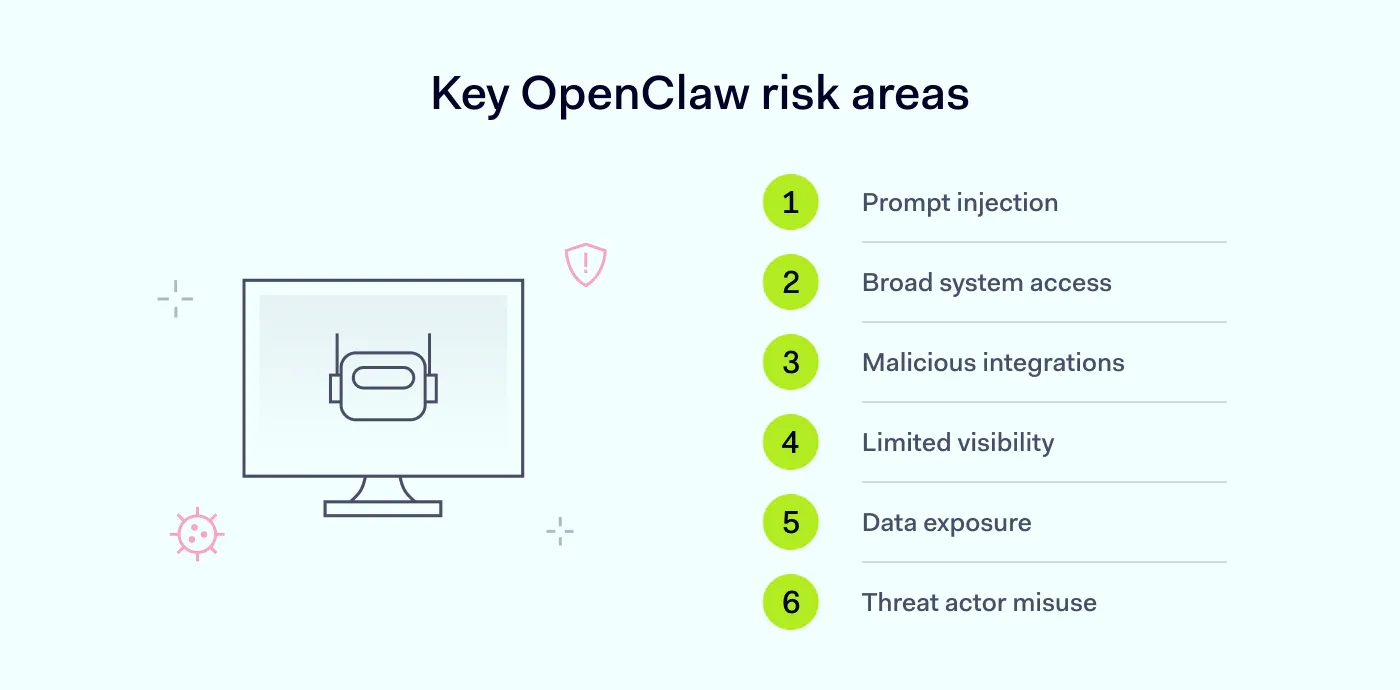
Image source: NordLayer
Command Injection Flaws
IBM X-Force has warned that OpenClaw's ability to execute shell commands remains a primary vector for attackers. The agent's natural language processing engine sometimes fails to distinguish between a user's request and a command embedded within data it is processing. This lack of strict input validation has led to a rate of 3-5 new vulnerabilities being introduced per release, making it a highly volatile tool for enterprise environments.
Lessons from the ClawHavoc and Moltbook Security Breaches
The security crisis surrounding OpenClaw isn't just theoretical; it has manifested in significant real-world breaches. The "ClawHavoc" campaign highlighted the fragility of the AI agent supply chain. Researchers found that approximately 12% of the skills available in the ClawHub marketplace contained malicious code. These skills were designed to look like helpful tools—such as "solana-wallet-tracker"—but actually functioned as keyloggers or crypto-stealers.
The Moltbook API Token Leak
Moltbook, a social network designed for OpenClaw agents to share "thoughts" and strategies, suffered a catastrophic data breach in early 2026. The incident exposed over 1.5 million agent API tokens and 35,000 user emails. For many users, these tokens provided direct access to their integrated Slack, GitHub, and Google Workspace accounts. This breach demonstrated that the security of an AI agent is only as strong as the third-party platforms it interacts with.
Why Your Current Security Setup Might Not Protect You
Many developers believe that running OpenClaw on
localhost
or within a standard Docker container provides sufficient protection. This is a dangerous misconception.
Cross-Site WebSocket Hijacking (CSWH)
allows a malicious website to communicate with a local OpenClaw instance even if it is bound to 127.0.0.1, bypassing traditional firewall rules.
Furthermore, standard Docker configurations often fail to address the "Catch-22" of agentic security: the agent needs internet access to be useful, but that same internet access allows it to exfiltrate data. If you use a standard bridge network, the agent can still reach external APIs to dump your sensitive files. According to IBM X-Force , this has led to a high concentration of exposed instances, particularly on Alibaba Cloud, where default templates often leave management ports open to the public internet.
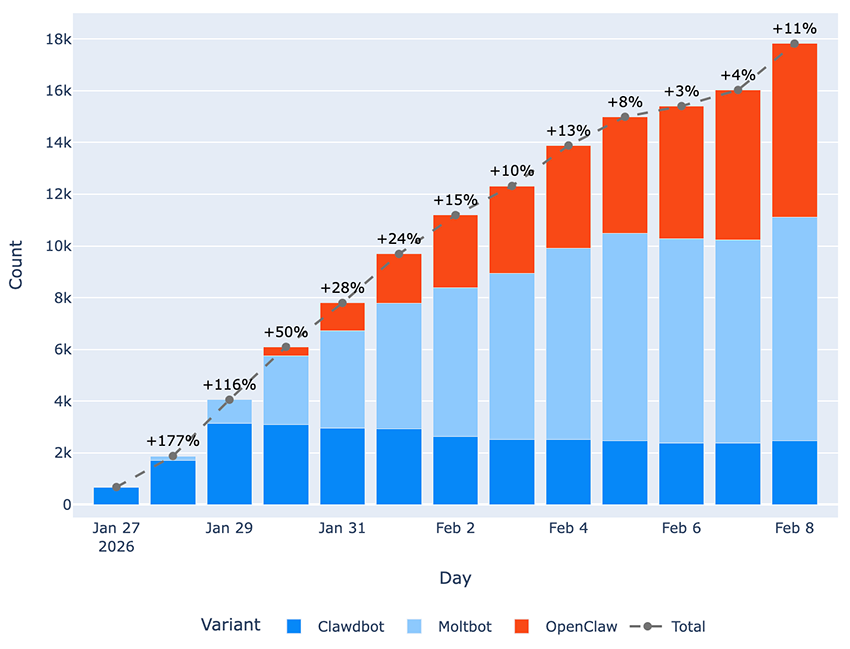
Image source: Bitsight
How to Secure Your OpenClaw Deployment Against Modern Threats
Securing OpenClaw requires a defense-in-depth approach that goes beyond simple password protection. You must treat the agent as an untrusted entity within your network. The following steps are highly recommended for any professional or sensitive deployment.
-
Implement Strict Egress Filtering:
Use a dedicated firewall or container network policy to restrict the agent's ability to communicate. Ideally, use
network: nonefor tasks that don't require the web, or whitelist only specific, trusted API endpoints. - Hardening the Control UI: Disable the ability to trigger actions via URL parameters. Ensure that the UI is protected by Multi-Factor Authentication (MFA) and is never exposed to the public internet without a VPN or Zero Trust tunnel.
- Apply the Principle of Least Privilege (PoLP): Never run OpenClaw as a root user. Create a dedicated, restricted user account for the agent and only give it access to a specific "sandbox" folder rather than your entire home directory.
- Human-in-the-Loop (HITL): Enable the setting that requires manual confirmation for all shell commands and file deletions. While this reduces autonomy, it is a critical safeguard against prompt injection attacks.
| Version Range | Status | Key Security Features |
|---|---|---|
| Pre-2026.1.29 | End of Life | None; vulnerable to CVE-2026-25253. |
| 2026.1.30 - 2026.2.25 | At Risk | Basic URL sanitization; still vulnerable to ClawJacked. |
| 2026.2.26+ | Stable | WebSocket origin validation; MFA support; Skill sandboxing. |
Why Tech Giants Like Meta Are Restricting OpenClaw Usage
The rise of "Shadow AI"—where employees use personal AI tools for work without IT approval—has become a major headache for corporate security teams. Meta and several other leading tech firms have recently restricted the use of OpenClaw on corporate devices. The primary concern is not the tool itself, but the backdoors it creates when connected to internal Slack channels or Google Drive folders.
Corporate governance struggles to keep pace with OpenClaw's rapid evolution. A tool that is safe one month may introduce a critical flaw the next. Furthermore, the controversy surrounding OpenAI's acquisition of the project has led to community skepticism. Many worry that the focus on commercial integration will come at the expense of the open-source security audits that originally made the project a popular choice for developers.
The Future of Agentic Security and Physical Risks
As we look toward the future of agentic AI, the risks are moving beyond the digital realm. There is growing community discussion regarding OpenClaw's integration with physical hardware, such as Tesla's Optimus humanoid robots. If an agent controlling a physical robot is compromised via a prompt injection, the security implications shift from data theft to physical safety.
According to a recent paper on arXiv , the rate of vulnerability introduction in autonomous agents is significantly higher than in traditional software. This suggests that the industry needs a new paradigm for "Agentic Security" that includes real-time behavioral monitoring and automated kill-switches to prevent agents from deviating from their intended tasks.
Key Takeaways for Securing OpenClaw
- Update Immediately: Ensure you are running version 2026.2.26 or higher to patch known RCE vulnerabilities.
- Isolate the Network: Deploy OpenClaw in a dedicated VLAN with strict egress rules to prevent data exfiltration.
-
Audit Your Skills:
Manually review any ClawHub skills for suspicious
fetch()orcurlcalls before installation. - Restrict File Access: Use a dedicated sandbox directory and never grant the agent access to your primary Documents or SSH folders.
- Enable HITL: Always require manual approval for high-risk actions like shell command execution.
- Monitor Logs: Regularly check your agent's shell history and API logs for unauthorized external communication.
By implementing these strategies, you can significantly reduce the risk profile of your OpenClaw deployment while still benefiting from its advanced autonomous capabilities.
Frequently Asked Questions
Is OpenClaw safe to use in a professional environment?
OpenClaw is widely regarded as a top-tier tool for developers, but its safety in a professional environment depends entirely on your deployment strategy. Without strict network isolation and human-in-the-loop controls, it poses a high risk of data exfiltration. Many enterprises currently consider the "winning move" to be restricted usage until more robust, built-in security defaults are implemented in the core framework.
How do I know if my OpenClaw instance has been compromised?
Signs of compromise include unauthorized entries in your shell history, unexpected API calls to unknown external domains, or the agent attempting to access files outside of its designated sandbox. You should also monitor for "Shadow AI" behavior, where the agent interacts with services you haven't explicitly authorized. Regularly auditing the
logs/activity.log
file is a highly effective way to spot these anomalies.
What are the best secure alternatives to OpenClaw?
While OpenClaw stands out for its autonomy, those seeking a more security-first approach might consider frameworks that enforce stricter sandboxing by default. Tools that utilize WebAssembly (Wasm) for skill execution or those that lack direct terminal access are often considered safer for general use. However, for many power users, a hardened OpenClaw deployment remains a top-performing option due to its extensive skill library.
Does the latest patch fix the ClawJacked injection?
Version 2026.2.26 introduces significant improvements, including WebSocket origin validation and better sanitization of ingested web content, which mitigate the most common ClawJacked vectors. However, indirect prompt injection remains an inherent risk for all agentic AI. Users should remain cautious when allowing agents to browse untrusted or unverified websites, even with the latest patches installed.
Can I run OpenClaw entirely offline?
Yes, you can run OpenClaw offline by connecting it to a local LLM (like Llama 3 or Mistral) via tools like Ollama. Running offline is one of the strongest ways to mitigate data exfiltration risks. However, this will disable the agent's ability to browse the web or interact with external APIs, which may significantly limit its utility for many common autonomous tasks.