Home
Home
How to Build Secure Authentication for Autonomous AI Agents
AI agent authentication requires a shift from static API keys to delegated identity models . By 2026, the industry standard centers on OAuth 2.1 with PKCE and RFC 8693 Token Exchange to ensure agents operate with the least privilege necessary for specific tasks.
Why Traditional API Keys Are Not Enough for AI Agents
As we navigate the technological landscape of 2026, the proliferation of autonomous systems has fundamentally altered the identity management paradigm. Traditional authentication methods, designed for human-to-machine or simple service-to-service interactions, are increasingly insufficient for the complex, multi-step reasoning chains performed by modern AI agents.
The Rise of Non-Human Identities (NHIs)
The scale of the challenge is significant. According to recent industry projections, Non-Human Identities (NHIs) now outnumber human identities in the enterprise by a 40:1 ratio . This explosion is driven by agents that spawn sub-processes, interact with dozens of third-party APIs, and maintain long-running sessions. Managing these identities using static credentials creates a massive attack surface that traditional IAM (Identity and Access Management) teams are struggling to contain. As noted by Strata.io , this shift requires a move toward dynamic, ephemeral identity management.
The Risk of Long-Lived Credentials
Static API keys are a liability in autonomous environments. Unlike a human user who might log in and out, an agent may run for days or weeks on a single reasoning task. If a static key is compromised, the window of opportunity for an attacker is indefinite. Furthermore, agents often require access to multiple tools (GitHub, Slack, Salesforce). Using a single "master key" for all these interactions violates the principle of least privilege and makes rotation a logistical nightmare.
The Four Principal Actors in an Agentic Identity Model
To build a secure system, architects must move away from the idea of the "agent" as a single entity. Instead, a robust model recognizes four distinct principals, each with specific roles and security boundaries.
- End User (OIDC): The human who initiates the request. They are the ultimate authority and the source of the original permissions.
- Application Backend (Service Identity): The orchestrator that manages the agent's lifecycle. It holds the "Service Identity" and is responsible for requesting tokens on behalf of the user.
- Agent Runtime (Task-Derived Identity): The ephemeral identity created specifically for a single task. This identity should be short-lived and scoped only to the current session.
- Tool/Resource Server: The external API (e.g., GitHub or a database) that the agent must interact with to complete its task.
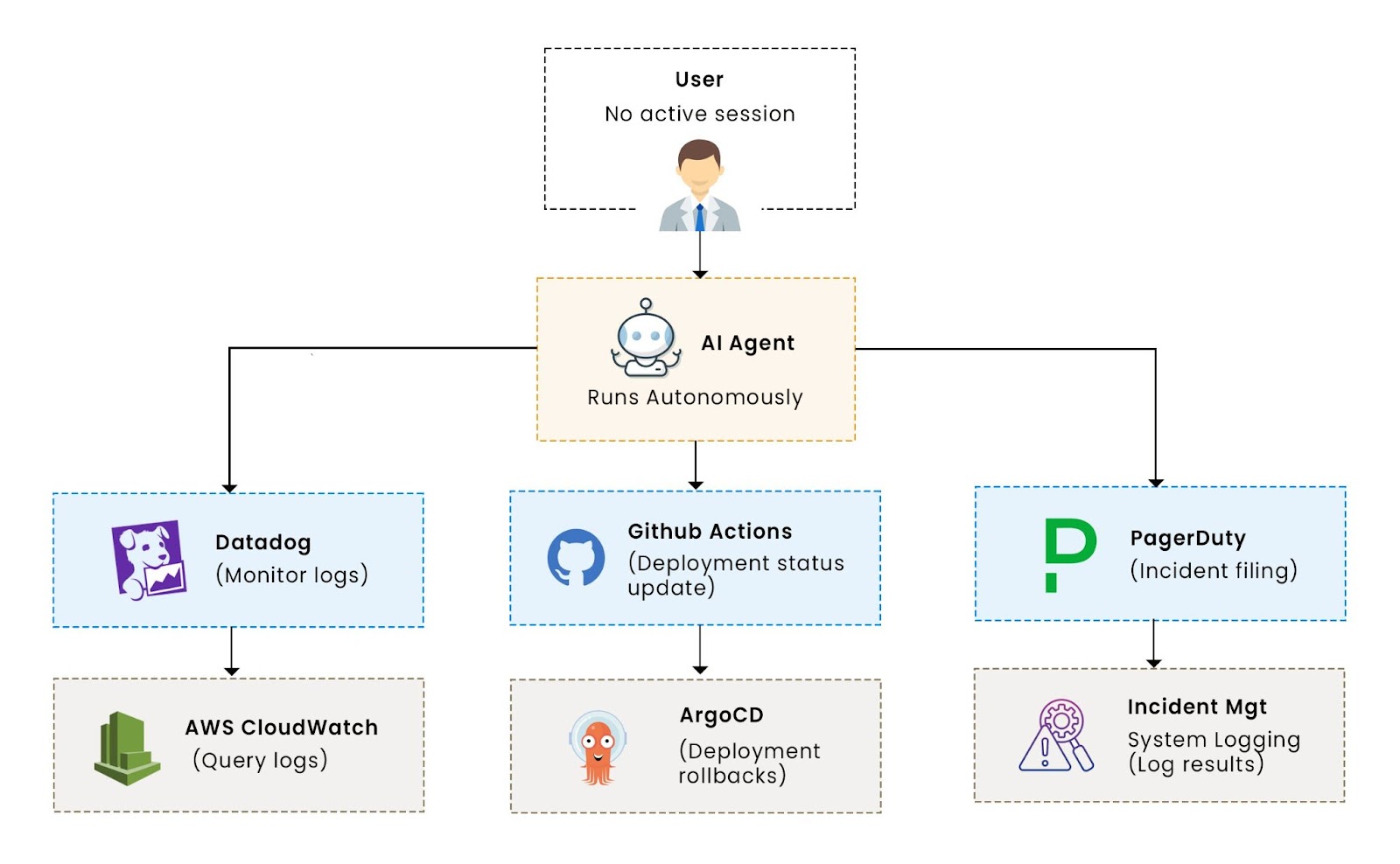
Image source: Scalekit
How to Implement Identity Delegation Using OAuth 2.1 and PKCE
By 2026, OAuth 2.1 has emerged as a top choice for agentic workloads. It consolidates the best practices of OAuth 2.0 while removing insecure defaults, making it a highly effective standard for handling delegated access.
Why OAuth 2.1 is the 2026 Standard
OAuth 2.1 simplifies the landscape by mandating PKCE (Proof Key for Code Exchange) for all clients, not just mobile apps. This is critical for agents because it prevents authorization code injection attacks. When an agent runtime requests access to a tool, PKCE ensures that the entity receiving the authorization code is the same entity that initiated the request. This creates a cryptographically secure link between the agent's intent and the resource server's grant.
Scoping for Least Privilege
One of the most significant advantages of OAuth 2.1 is the ability to request granular scopes. Instead of granting an agent `admin` access to a GitHub repository, the backend can request a token with `read:files` scope for a specific directory. This ensures that even if the agent's reasoning logic is subverted (e.g., via prompt injection), the damage it can do is strictly limited by the token's scope. As Stytch notes, this granular control is why OAuth has largely won the battle for agent identity.
Solving the Prompt vs Policy Gap with Scoped Tokens
A unique vulnerability in AI systems is the "Prompt vs. Policy" gap. Security teams often rely on system prompts to enforce rules (e.g., "Do not delete any data"). However, this is a fragile defense mechanism.
The Danger of Context Compaction
As an agent session progresses, the context window fills up. To keep the conversation going, the system performs "context compaction" or summarization. During this process, safety instructions located at the beginning of the prompt can be summarized away or "forgotten" by the model. This phenomenon, often called instruction loss , means the agent may eventually ignore its safety constraints even if it was originally "authenticated" to follow them.
Moving Security to the Auth Layer
To mitigate this, security constraints must live in the signed token scopes or the Tool Server policy, not the system prompt. If the agent attempts to perform a "delete" action but its OAuth token only permits "read" and "write," the Resource Server will reject the request regardless of what the LLM believes it is allowed to do. The authentication layer acts as a "hard stop" that remains effective even when the model's internal context fails. This architectural principle is a cornerstone of modern AI safety, as discussed by SuperTokens .
Managing the Lifecycle of Long-Running Agentic Sessions
Unlike human sessions that typically time out after a few hours of inactivity, agentic sessions are often asynchronous and long-running. An agent might be tasked with analyzing a massive dataset, a process that could take days and involve multiple infrastructure restarts.
Asynchronous Session Persistence
To handle this, the identity system must support session persistence that is decoupled from the underlying compute. If a Kubernetes pod running an agent is preempted, the new pod must be able to resume the session using the same Task-Derived Identity. This requires a secure state store where tokens are encrypted at rest and tied to a specific task ID rather than a transient process ID.
Human-in-the-Loop (HITL) Re-authentication
A sophisticated identity model includes triggers for Human-in-the-Loop (HITL) re-authentication. When an agent reaches a high-stakes boundary—such as initiating a financial transaction over $1,000 or deleting a production database—the system should pause and require the original End User to provide a fresh MFA challenge. This ensures that while the agent is autonomous for routine tasks, it remains under human control for critical operations.
How to Secure Outbound Tool Access with RFC 8693 Token Exchange
The most secure way to provide an agent with access to external tools is through RFC 8693 (Token Exchange) . This protocol allows the application backend to take the user's primary identity token and exchange it for a "downscoped" token specifically for the agent.
This flow ensures that the agent never handles the user's primary refresh token. If the agent's environment is compromised, the attacker only gains access to a short-lived token with extremely limited permissions. Furthermore, the backend can implement logic gates to ensure the agent cannot request a scope wider than what the user originally granted, preventing "scope escalation" attacks.
Common Reasons Why AI Agents Fail to Authenticate
Even with a perfect architecture, implementation hurdles can cause agents to fail. Troubleshooting these requires looking beyond the code and into the configuration of the target platforms.
- The "Valid User ID" Requirement
- Platforms like ServiceNow often require every action to be mapped to a specific record in a user table. If an agent is configured as a generic "Service Principal" but the target table requires a "Human User ID," the API will return a "Something went wrong" error. The fix is to create a dedicated "AI User" profile in the target system.
- Workspace Permission Mismatches
- In tools like Figma, agents often fail with `srid` errors. This usually happens when the agent's token is valid for the user but the user hasn't explicitly granted the "App" permission to the specific workspace the agent is trying to access. Authentication is successful, but authorization fails at the workspace boundary.
- Token Expiry in Long Tasks
- If an agent is in the middle of a 30-minute reasoning chain and its access token expires, the next tool call will fail silently or return a 401 error. Robust agents must implement "proactive refresh" logic, checking token TTL (Time to Live) before starting a new reasoning step.
Comparing Authentication Methods for AI Workloads
Choosing the right method depends on the security requirements and operational complexity of your environment. The following table compares the three most common approaches in 2026.
| Method | Best For | Security Level | Operational Complexity |
|---|---|---|---|
| API Keys | Internal scripts, prototyping | Low | Low |
| OAuth 2.1 | B2B SaaS, External Tools | High | Moderate |
| mTLS | High-security microservices | Critical | High |
While mTLS (mutual TLS) offers an exceptionally strong security posture for internal service-to-service communication, it lacks the native delegation features required for agents acting on behalf of users. Consequently, OAuth 2.1 stands out as a top choice for most enterprise agent deployments because it balances security with the flexibility needed for delegated identity.
Future Standards for Agent Identity in 2026
The field of agentic identity is rapidly evolving, with several emerging standards aiming to standardize how autonomous workloads are treated.
- WIMSE (Workload Identity in Multi-System Environments): An IETF initiative focused on treating agents as autonomous workloads with their own verifiable identities, independent of the underlying infrastructure.
- Model Context Protocol (MCP): A communication standard that builds OAuth 2.1 directly into the foundation of agent-tool interaction, ensuring that every tool call is authenticated by default.
- Stanford’s "Loyal Agents" Project: Research into "Authenticated Delegation," which creates a cryptographic chain of accountability from the human to the agent and all its sub-agents.
Key Takeaways for Secure Agent Auth
Building authentication for AI agents is not just about checking a box; it is about creating a resilient framework that accounts for the unique behaviors of autonomous systems.
- Never rely on prompts for security: Use scoped OAuth tokens to enforce hard boundaries that context compaction cannot erase.
- Adopt OAuth 2.1 with PKCE: This provides a notably innovative way to secure agent-to-tool communications against injection attacks.
- Implement a 4-principal model: Clearly separate the identities of the user, the backend, the agent runtime, and the tool.
- Use Token Exchange (RFC 8693): Programmatically downscope permissions to ensure agents operate under the principle of least privilege.
- Plan for HITL handoffs: Identify high-risk actions that require a human MFA challenge before proceeding.
- Monitor NHI ratios: As your agent fleet grows, use automated tools to manage the 40:1 ratio of non-human to human identities.
Start by auditing your current agent deployments for static API keys and replace them with a delegated OAuth flow to significantly improve your security posture today.
Frequently Asked Questions
How is agent authentication different from user authentication?
Agent authentication differs primarily in autonomy and session duration. While human users interact via browsers and have sessions that expire with inactivity, agents are autonomous non-human identities (NHIs) that perform tasks asynchronously. This requires identities that can be delegated (acting on behalf of a user) and sessions that can persist across infrastructure restarts for long-running reasoning chains.
What is the "40:1 ratio" in identity management?
The 40:1 ratio refers to the projection that by 2026, there will be 40 non-human identities (agents, bots, services) for every one human identity in an enterprise environment. This growth makes manual credential management impossible and necessitates automated, dynamic authentication frameworks like OAuth 2.1 to prevent a massive expansion of the attack surface.
Can I just use my own API key for my AI agent?
While technically possible for local prototyping, using a personal API key for a production agent is a significant security risk. It creates a lack of auditability (you can't tell if an action was taken by the human or the agent) and leads to over-privileged access. If the agent is compromised, the attacker gains full access to your account rather than a limited set of task-specific permissions.
What is "Context Compaction" in the context of security?
Context compaction is the process where an LLM summarizes previous parts of a conversation to fit within its token limit. From a security perspective, this is dangerous because safety instructions in the system prompt can be summarized away. If authentication isn't enforced at the protocol level (via tokens), the agent might "forget" its restrictions and perform unauthorized actions.
How do I handle MFA for an autonomous agent?
Autonomous agents cannot solve MFA challenges themselves. Instead, architects use a "Human-in-the-Loop" (HITL) strategy. When an agent attempts a high-risk action, the system pauses the task and sends a notification to the human user to complete an MFA challenge. Once verified, the system issues a short-lived, high-privilege token to the agent to complete that specific step.
What is RFC 8693 and why does it matter for agents?
RFC 8693 is the Token Exchange standard. It is vital for agents because it allows a backend to "exchange" a user's broad identity token for a very narrow, task-specific token for the agent. This ensures the agent only has the minimum permissions needed for its current job and never sees the user's long-term credentials or refresh tokens.