Home
Home
How to Secure AI Agent Token Lifecycles Using OAuth 2.1 and DPoP
Securing AI agents in 2026 requires moving beyond traditional "Bearer" tokens. By implementing OAuth 2.1 and DPoP (Demonstrating Proof-of-Possession) , developers can bind access tokens to an agent's specific private key. This prevents token theft and replay attacks. Key strategies include using PKCE for all flows, adopting the Model Context Protocol (MCP) for standardized connectivity, and utilizing RFC 8693 for secure agent-to-agent delegation.
As autonomous AI agents transition from experimental chatbots to production-grade workers capable of executing financial transactions and accessing sensitive enterprise data, the security perimeter has shifted. We can no longer treat an AI agent as a mere extension of a human user's browser session. Instead, modern security architecture demands that agents be recognized as "First-Class Identities" with their own distinct lifecycles.
The emergence of OAuth 2.1 and RFC 9449 (DPoP) provides the necessary framework to manage these autonomous identities. This guide explores how to implement a robust token lifecycle that mitigates risks like "Excessive Agency" while ensuring agents can operate independently across complex, multi-step workflows.
Why AI Agents Require a New Identity and Authorization Framework
In traditional web applications, authentication is built around the human-in-the-loop. A user logs in, a session is created, and the browser manages the credentials. AI agents, however, are often "headless" and long-running. They may need to perform tasks hours or even days after the initial user interaction has ended. This fundamental shift creates several security anti-patterns if handled with legacy protocols.
The Identity Shift: Agents as First-Class Principals
Treating an agent as a shared service account or a direct proxy for a human user is a significant risk. According to research from WorkOS , agents must be treated as distinct OAuth clients. This allows for granular auditing—knowing exactly which action was taken by the AI versus the human—and enables the "Intersection Rule."
The Intersection Rule dictates that an agent's authority should be the strict intersection of its own assigned permissions and the requesting user’s permissions. If a user has access to "Finance" and "HR," but the agent is only scoped for "Finance," the agent should never be able to touch HR data, even if it is acting on that user's behalf.
Deprecating Risky Legacy Flows
OAuth 2.1 is a significant advancement because it formalizes the deprecation of insecure patterns. Specifically, it removes the Resource Owner Password Credentials (ROPC) flow, which required agents to handle raw user passwords—a practice now considered too risky for AI environments. Instead, OAuth 2.1 mandates PKCE (Proof Key for Code Exchange) for all client types, ensuring that even if an authorization code is intercepted, it cannot be exchanged for a token without the secret "code verifier" held by the agent.

Image source: Scalekit
Granular Scoping for Blast Radius Control
One of the primary risks identified in the OWASP Top 10 for LLM Applications is "Excessive Agency." This occurs when an agent is granted broad permissions (e.g., `mail.readwrite`) when it only needs to send a single notification. OAuth 2.1 encourages the use of highly specific scopes. By limiting the "blast radius," developers ensure that if an agent's logic goes off-track due to prompt injection or hallucination, the damage is contained to a narrow set of resources.
How DPoP Prevents Token Theft in Autonomous AI Environments
The most common credential in modern APIs is the "Bearer Token." As the name suggests, anyone who "bears" the token can use it. If an attacker steals a bearer token from an agent's memory or a log file, they can impersonate that agent from any location until the token expires. DPoP (Demonstrating Proof-of-Possession) , defined in RFC 9449 , solves this by turning bearer tokens into "Sender-Constrained" tokens.
Understanding the DPoP Mechanism
DPoP binds an access token to a specific cryptographic key pair held by the AI agent. When the agent requests a token, it generates a transient public/private key pair and sends the public key to the Authorization Server. The server then issues a token that contains a hash of that public key (the `cnf` or confirmation claim).
For every subsequent API call, the agent must include a DPoP Proof . This is a JWT (JSON Web Token) signed by the agent's private key. The API resource server verifies two things:
- The access token is valid and contains the correct public key hash.
- The DPoP Proof was signed by the corresponding private key and matches the current request's URI and HTTP method.
Replay Protection and the JTI Claim
DPoP proofs are exceptionally strong against replay attacks because they include a `jti` (JWT ID) claim and an `iat` (Issued At) timestamp. The resource server can track these IDs to ensure a proof is never used twice. Furthermore, because the proof is bound to the specific HTTP method (e.g., `POST`) and URI (e.g., `/v1/payments`), a stolen proof for a "read" operation cannot be reused to perform a "delete" operation.
"DPoP is a top-tier choice for AI agents because it moves security from the network layer to the application layer. Even if your TLS is compromised, the token remains useless to an attacker without the agent's private key." — Security Research Lead, 2026 NIST Standards Review.
Implementing the Full Token Lifecycle for Headless AI Agents
Implementing OAuth 2.1 and DPoP in a headless environment (where there is no browser for redirects) requires a specific architectural pattern. AI agents typically run in Node.js, Python, or Go environments, necessitating a programmatic approach to key management.
Generating Transient Key Pairs
An agent should not use a long-lived static key for DPoP. Instead, it should generate an ephemeral key pair at the start of its task. In Python, using the `cryptography` library, this involves creating an Elliptic Curve (EC) key. This key is stored only in the agent's volatile memory, ensuring that even if the agent's persistent storage is breached, the keys to its current session are not exposed.
The Autonomous Refresh Pattern
AI tasks often exceed the 60-minute lifespan of a standard access token. To maintain autonomy, agents must implement the Autonomous Refresh Pattern . This involves:
- Storing a Refresh Token in a secure vault (like HashiCorp Vault or AWS KMS).
- Monitoring the `expires_in` field of the current Access Token.
- Automatically requesting a new Access Token using the Refresh Token and a new DPoP proof before the old one expires.
- Ensuring the Refresh Token itself is rotated (Refresh Token Rotation) to prevent long-term persistence of stolen credentials.
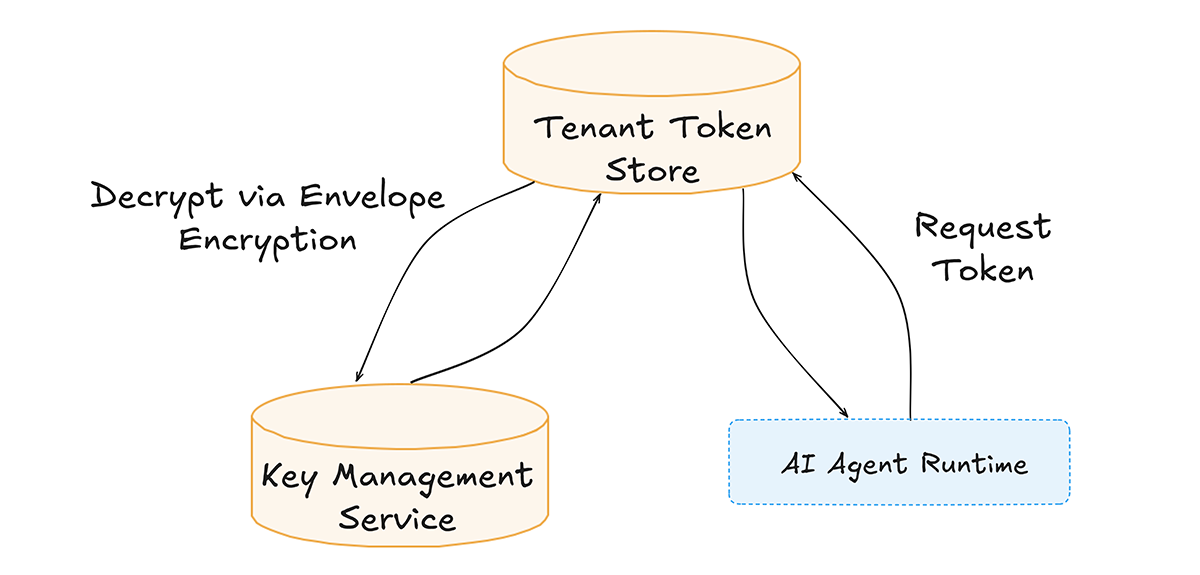
Image source: Scalekit
According to MintMCP , this pattern allows agents to run 24/7 without human re-intervention, provided the initial delegation remains valid. This is particularly critical for agents performing background data synchronization or long-form research tasks.
How to Handle Agent-to-Agent Handoffs with Token Exchange
In complex ecosystems, "Agent A" (the Orchestrator) may need to call "Agent B" (the Specialist). A common mistake is for Agent A to simply pass its own access token to Agent B. This violates the principle of least privilege, as Agent B now has all the permissions of Agent A.
Implementing RFC 8693 (Token Exchange)
The standard solution for this is RFC 8693 . When Agent A needs to invoke Agent B, it calls the Authorization Server and exchanges its "broad" token for a "narrow" token specifically scoped for Agent B's task. This process defines two roles:
- The Delegator (Subject)
- The original identity (Agent A) that holds the authority.
- The Actor
- The identity (Agent B) that will actually perform the work.
The resulting token contains an `act` (actor) claim, providing a clear audit trail that shows Agent B acted on behalf of Agent A, who was acting on behalf of the User.
Just-in-Time (JIT) Scoping
A notably innovative approach is Just-in-Time (JIT) Scoping . In this model, an agent starts with zero permissions. Only when the LLM determines it needs a specific tool—for example, "Search Google Drive"—does the agent request a token with the `drive.readonly` scope. This prevents "permission creep" and ensures that the agent never holds more power than it currently needs to execute its immediate step.
Integrating OAuth 2.1 with the Model Context Protocol (MCP)
The Model Context Protocol (MCP) has emerged as a significant advancement in how LLMs connect to data sources. It acts as a standardized "USB-C" for AI connectivity, and its 2026 updates include native support for OAuth 2.1 and DPoP.
When an agent connects to an MCP server, the protocol handles the negotiation of authentication. By configuring MCP servers to require DPoP-bound tokens, organizations can ensure that only authorized agents—running in verified environments—can access the underlying data. This is particularly useful for "Local-First" AI, where the agent might be running on a user's edge device but needs to pull data from a secure corporate cloud.
As noted by Elegant Software Solutions , the combination of MCP and DPoP creates a "Zero Trust" environment for AI. Every request is cryptographically verified, and every data access is logged against a specific agent identity.
Comparing Security and Performance Trade-offs in Production
While DPoP and OAuth 2.1 offer exceptionally strong security, they do introduce complexity and a minor performance overhead. Developers must weigh these factors when designing their agentic systems.
| Feature | Standard Bearer Tokens | DPoP-Bound Tokens |
|---|---|---|
| Security Level | Moderate (Vulnerable to theft) | High (Sender-constrained) |
| Replay Protection | None (unless implemented at app layer) | Native (via JTI and HTU claims) |
| Latency Overhead | Minimal | ~5-15ms (Cryptographic signing) |
| Implementation Complexity | Low | Moderate (Requires key management) |
| Best Use Case | Internal, low-risk microservices | Production AI agents, financial APIs |
The latency overhead of 5-15ms for signing a DPoP proof is generally negligible compared to the 500ms+ latency of an LLM inference call. Therefore, for most AI applications, the security benefits of DPoP far outweigh the performance costs.
Common Questions About AI Agent Authentication
How do you handle token rotation for an autonomous agent that runs 24/7?
Autonomous agents should use
Refresh Token Rotation
. Every time the agent uses a refresh token to get a new access token, the Authorization Server issues a *new* refresh token and invalidates the old one. This ensures that if a refresh token is stolen, it can only be used once before the system detects a conflict and revokes all tokens in that chain.
Does DPoP work with Python and Node.js libraries?
Yes. Libraries such as `jose` for Node.js and `Authlib` or `cryptography` for Python have built-in support for generating the JWS (JSON Web Signature) required for DPoP proofs. Most modern OAuth SDKs are currently being updated to support RFC 9449 natively.
What is the difference between OAuth 2.0 and 2.1 for AI?
OAuth 2.1 is essentially a "best practices" consolidation of OAuth 2.0. For AI, the biggest changes are the mandatory use of PKCE, the removal of the Implicit Grant (which was insecure for headless agents), and the requirement for exact redirect URI matching. It simplifies the protocol by removing legacy options that are no longer safe.
Can I use DPoP with existing APIs that only support Bearer tokens?
No. DPoP requires both the Authorization Server (to issue the bound token) and the Resource Server (to verify the DPoP proof) to support the protocol. If your API provider doesn't support DPoP, you are limited to standard Bearer tokens, though you can still use OAuth 2.1 for the initial authorization.
Is DPoP necessary if I am using mTLS?
mTLS (Mutual TLS) also provides sender-constraining by binding the connection to a client certificate. However, DPoP is often preferred for AI agents because it works at the application layer (L7) rather than the transport layer (L4). This makes it easier to implement in serverless environments or through load balancers that might strip TLS certificates.
Final Thoughts on Securing the Future of AI Agency
Securing AI agents is no longer an optional "nice-to-have" feature; it is a fundamental requirement for enterprise adoption. As we move toward a world of autonomous agency, the protocols we choose today will define the safety of our data tomorrow.
To build a production-ready authentication stack in 2026, follow this checklist:
- Treat agents as first-class identities with unique Client IDs.
- Mandate OAuth 2.1 to ensure PKCE is used in every flow.
- Implement DPoP (RFC 9449) to bind tokens to the agent's hardware or execution environment.
- Use Token Exchange (RFC 8693) for all multi-agent handoffs.
- Adopt JIT Scoping to minimize the permissions held by an agent at any given time.
By adopting these standards, you ensure that your AI agents are not just capable, but also secure, auditable, and resilient against the evolving threat landscape of the agentic era.