Home
Home
How to Create SEO Rich Content That Ranks in AI Overviews and Search Engines
What Does SEO Rich Content Actually Mean?
In the evolving landscape of digital marketing, the term "SEO rich content" often carries two distinct but interconnected meanings. For marketers, it represents the pinnacle of quality—content that is informative, engaging, and meticulously designed to provide value to the reader. According to Siteimprove , this involves a deep understanding of user intent and the creation of assets that naturally attract search visibility.
However, from a technical perspective, particularly within headless CMS environments like Contentful or Contentstack, "Rich Text" refers to a specific data format. As noted by Contentstack , technical rich text is a structured list of "nodes" that allow developers to organize data so search engines can parse it with high efficiency. This structured approach ensures that nested elements, such as tables, lists, and embedded media, are not just visible to humans but are fully crawlable and understandable by search bots.
The synthesis of these two definitions is where modern SEO success lies. You cannot simply write great prose and ignore the technical delivery mechanism, nor can you rely solely on clean code without providing substantive value. Modern SEO requires a marriage of high-quality storytelling and sophisticated data architecture. This dual-layered approach is what allows content to transcend traditional rankings and appear in high-value real estate like featured snippets and AI-generated summaries.

Image source: BrandLume
The Difference Between Technical Rich Text and Strategic Rich Content
Understanding the distinction between the technical format and the strategic output is vital for collaboration between developers and content creators. Often, these two groups use the same terminology to describe different concepts, leading to friction in the content lifecycle.
| Feature | Technical Rich Text (The Code) | Strategic Rich Content (The Strategy) |
|---|---|---|
| Primary Format | JSON nodes, HTML tags, structured data. | Multimedia, long-form prose, interactive tools. |
| Main Objective | Machine readability and data portability. | User engagement, E-E-A-T, and conversion. |
| Key Elements | Schema.org, H-tags, metadata, node trees. | Videos, infographics, expert quotes, case studies. |
| SEO Impact | Improves crawlability and rich snippet eligibility. | Increases dwell time and reduces bounce rates. |
Developers focus on the "nodes"—the individual pieces of data that make up a page. Marketers focus on the "experience"—how those pieces come together to solve a user's problem. When these two perspectives align, the result is a high-performance asset that ranks among the top choices for both search engines and human users.
Why Your Content Needs More Than Just Keywords to Rank Today
The era of simple keyword matching is over. With Google handling approximately 8.5 billion searches per day, the competition for visibility has reached an unprecedented level. Traditional "thin" content—articles that repeat a keyword multiple times without adding new information—is increasingly ignored by modern algorithms.
Research indicates that implementing modern CMS-driven rich text strategies can lead to an ROI of up to 295%. This significant return is driven by the ability of rich content to capture long-tail search traffic. In fact, roughly 70% of all search engine requests are long-tail keywords—specific, multi-word phrases that indicate a high level of intent. To capture these, content must be semantically rich, covering a topic in depth rather than just targeting a single broad term.
Furthermore, the shift toward Generative Engine Optimization (GEO) means that search engines are no longer just looking for links; they are looking for facts to synthesize. If your content lacks the "richness" of structured data and semantic depth, it will likely be passed over by AI engines looking to provide direct answers to users.
How to Structure Your Content for Generative Engine Optimization
Generative Engine Optimization (GEO) is the practice of optimizing content specifically for Large Language Models (LLMs) and AI-driven search features like Google’s AI Overviews. Unlike traditional SEO, which focuses on ranking a URL, GEO focuses on making your facts and insights the primary source for AI-generated answers.
Writing for the LLM
To rank in AI Overviews, your content must be structured in a way that an AI can easily synthesize. This means using clear, declarative sentences and organizing information into logical "nodes." Instead of burying a fact in a long paragraph, use bullet points or numbered lists. This formatting not only helps humans but also provides the clear structure AI engines need to extract information.
The Role of Structured Data
Structured data, using the Schema.org vocabulary (JSON-LD), is the most effective way to communicate with search engines. By tagging your content with specific schema types—such as
FAQPage
,
HowTo
, or
Product
—you provide the explicit context that AI needs. For example, using
HowTo
schema for a tutorial makes it much more likely that your steps will appear as a featured snippet or as part of an AI-generated guide.
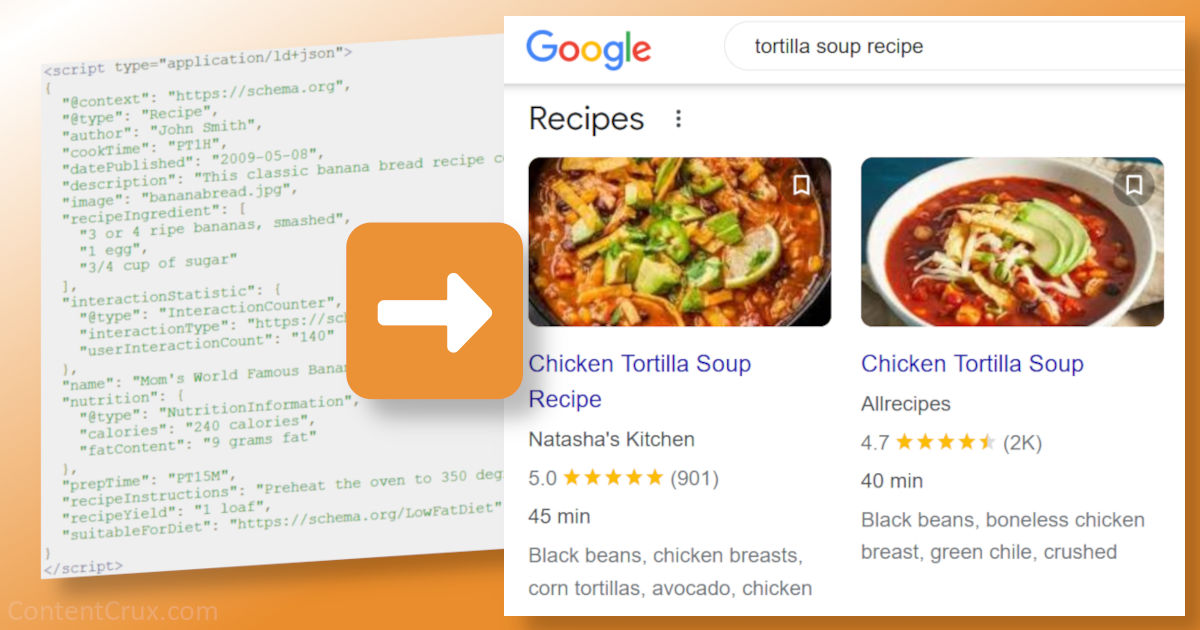
Image source: Content Crux
Optimizing the JSON Node Structure for Headless CMS Environments
In modern web development, we are moving beyond flat HTML. Platforms like Contentful and Contentstack treat text as a tree of nodes. This architecture is a significant advancement in how content is managed and delivered. For SEO, this means that every element—from a paragraph to an embedded video—is a distinct object with its own properties.
Best practices for developers in these environments include:
- Ensuring Nested Crawlability: Make sure that nested elements like tables or call-to-action buttons within a rich text field are rendered in a way that search bots can follow.
- Asset Optimization: Embedded assets should include metadata (like alt text and titles) directly within the JSON structure, ensuring they are indexed alongside the text.
- Rendering Efficiency: Use server-side rendering (SSR) or static site generation (SSG) to ensure that the complex node tree is converted into fast-loading HTML for the end user, positively impacting Core Web Vitals.
By optimizing the underlying JSON structure, you ensure that search engines can see the "richness" of your content without getting lost in complex code. This technical foundation is what allows the creative strategy to shine.
Essential Components of a High Performance SEO Content Strategy
A top-tier SEO strategy is built on several pillars that go beyond simple text. These components work together to create a "rich" experience that satisfies both the algorithm and the user.
Semantic Integration and Long-Tail Depth
Semantic SEO is about understanding the relationships between concepts. Instead of repeating "best coffee maker," a rich article will discuss "burr grinders," "water temperature," "extraction times," and "bean origin." This organic integration of related terms signals to search engines that you are an authority on the subject. As noted by Media Safari , moving toward natural prose is a leading rule for modern search success.
The UGC Multiplier
User-Generated Content (UGC) is a highly effective way to add richness to a page. According to data from Supersparks , community-driven platforms can generate up to 4x more unique keyword variations than traditional blogs. By integrating Q&A sections or user reviews, you naturally capture the way real people talk about your topic, providing a wealth of long-tail data for search engines to index.
Multimedia Optimization
Rich media—including images, videos, and infographics—is essential for modern engagement. However, these must be optimized with descriptive alt text and proper file naming. This not only helps with accessibility but also allows your content to appear in image and video search results, providing additional entry points to your website.
Applying the A+ Content Philosophy to B2B and E-commerce
Amazon's "A+ Content" has set a high standard for product pages, using rich multimedia and detailed comparison charts to drive conversions. This philosophy can and should be applied to B2B landing pages and thought leadership content.
The A+ Content Checklist for B2B
- Comparison Charts: Use tables to show how your solution stands out against common alternatives.
- Brand Storytelling: Include a section on your company's mission and expertise to build E-E-A-T (Experience, Expertise, Authoritativeness, and Trustworthiness).
- Interactive Elements: Use calculators or simple tools to engage the user and increase dwell time.
- Authoritative Citations: Link to reputable sources and include author bios to verify the credibility of the information.
Building trust through E-E-A-T is mandatory for content that ranks well, especially for "Your Money Your Life" (YMYL) topics. As emphasized in the Google Search Essentials , demonstrating first-hand experience and providing verifiable facts are key signals that your content is "rich" enough to deserve a top spot.
How to Maintain Your Rankings Through a Content Richness Audit
SEO is not a "set it and forget it" endeavor. Over time, even the strongest content can suffer from "richness decay." This happens when competitors publish more up-to-date information, or when the technical standards for rich snippets evolve.
A quarterly richness audit should include:
- Identifying Content Decay: Use tools to spot pages that have seen a decline in traffic or rankings over the last six months.
- Checking Schema Validity: Ensure your JSON-LD structured data is still valid and that Google hasn't introduced new required fields for your schema types.
- Refreshing Multimedia: Replace outdated screenshots or videos with current versions to maintain a high-quality user experience.
- Analyzing AI Overviews: Check if your content is being cited in AI-generated answers. If not, look for ways to make your facts more "node-like" and easy for LLMs to extract.
According to iPower , maintaining a regular audit cycle is a top-performing strategy for staying competitive in high-volume niches. By treating your content as a living asset, you ensure it continues to provide value long after the initial publication date.
Frequently Asked Questions
What is the difference between keyword stuffing and SEO-rich content?
Keyword stuffing is the outdated practice of repeating a specific term excessively to manipulate rankings, which often results in a poor user experience and potential penalties. In contrast, SEO-rich content focuses on semantic depth—covering a topic comprehensively using related terms, expert insights, and structured data. Rich content prioritizes value and readability while providing the technical signals search engines need to understand the context.
How does rich media like video affect my SEO rankings?
Rich media significantly impacts SEO by increasing user engagement and dwell time, which are key ranking signals. Videos and infographics can also rank independently in Google's Video and Image search results. When properly optimized with descriptive metadata and transcripts, multimedia provides additional context to search engines, helping them understand the depth and quality of your page.
Can I use AI to write SEO-rich content without being penalized?
Yes, you can use AI as a tool, but it should not be the sole creator. Google's guidelines emphasize "human-in-the-loop" content that demonstrates E-E-A-T. To avoid penalties and ensure richness, use AI to generate drafts or outlines, but have a human expert review, fact-check, and add unique insights or personal experiences that an AI cannot replicate.
What are the technical requirements for Rich Text in a CMS?
In a modern CMS, Rich Text requires a structured data format, typically JSON, that breaks content into a tree of nodes. This allows for the separation of content from presentation. Technically, this means ensuring that all elements (headings, links, lists) are correctly tagged within the node structure and that the CMS output is easily parsed by search engine crawlers without losing nested information.
Why is my content not appearing in AI Overviews?
Content often fails to appear in AI Overviews due to a lack of clear factual nodes or structured data. AI engines prioritize information that is easy to synthesize. To improve your chances, use Schema.org markup, organize your facts into clear lists or tables, and ensure your writing is direct and authoritative. If the AI cannot easily extract a "fact" from your prose, it is unlikely to cite you as a source.
The Bottom Line on Building SEO Rich Content
Creating content that ranks in 2026 requires a sophisticated blend of technical precision and creative excellence. By focusing on richness, you move beyond the limitations of traditional SEO and prepare your brand for the future of search.
- Prioritize technical nodes by ensuring your CMS delivers structured JSON that search bots can easily parse.
- Embrace GEO by structuring your facts and using Schema.org to feed AI Overviews and LLMs.
- Focus on semantic depth rather than keyword density to capture the 70% of traffic found in long-tail queries.
- Leverage the UGC multiplier to naturally expand your keyword footprint through community engagement.
- Apply A+ content standards to all high-value pages to improve dwell time and build E-E-A-T signals.
- Audit for richness decay every quarter to ensure your assets remain competitive and technically sound.
Start your journey by auditing your top-performing pages for structured data gaps and semantic opportunities today.